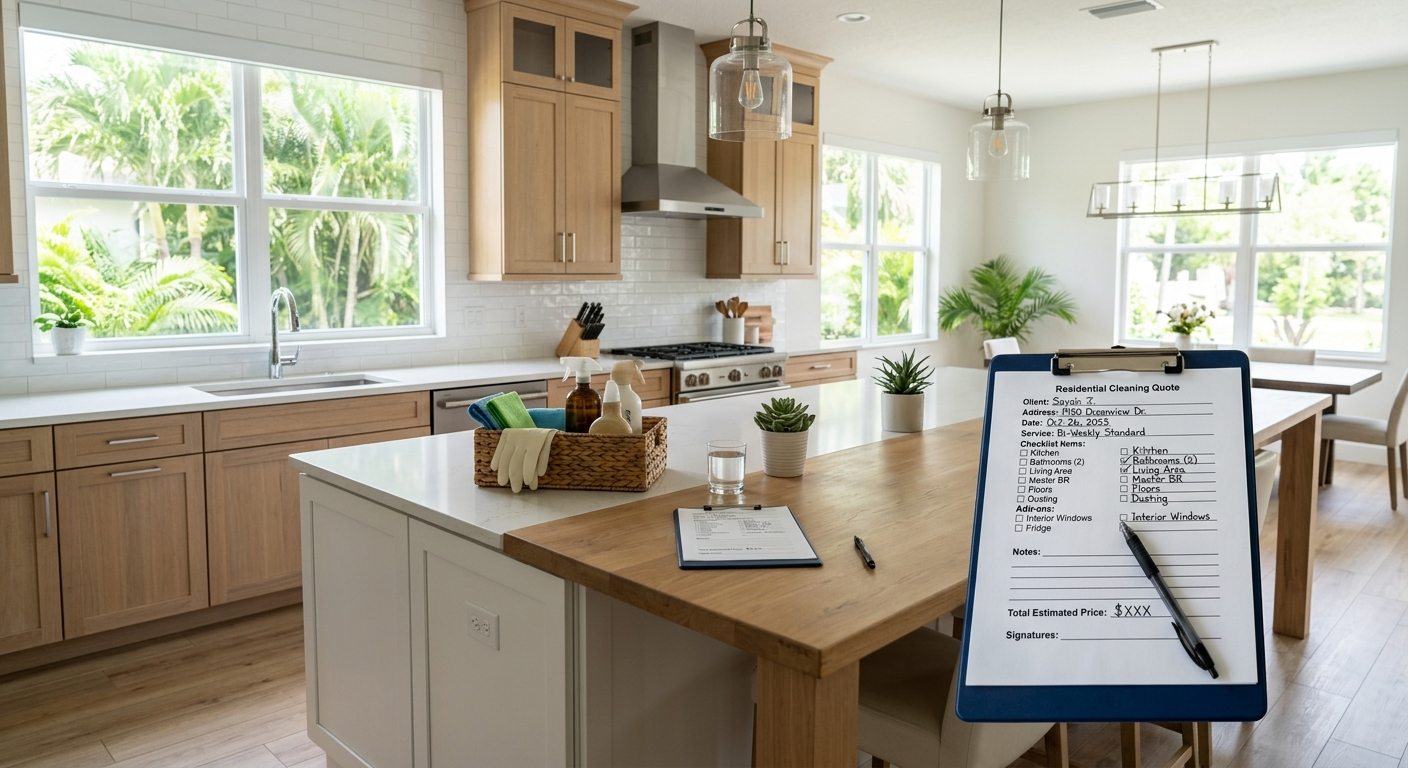
You request three quotes for the exact same house and get back three wildly different numbers — say $140, $220, and $310. It feels random, maybe even like someone's trying to take advantage of you. We get this question constantly, and after years of quoting jobs across South Florida, we can tell you: why do cleaning quotes vary so much is one of the most common — and most reasonable — questions a homeowner can ask.
The honest answer is that the spread isn't arbitrary. It reflects real differences in business models, labor costs, insurance coverage, and what's actually included in the job. In this breakdown, we'll walk through the specific factors that create that gap, using real 2026 pricing data, so you can evaluate a quote like someone who actually works in this industry.
What You'll Learn
- The national pricing ranges for standard, deep, and move-out cleaning in 2026
- Why an independent cleaner's rate and a company's rate can differ by $20+ per hour
- What a "loaded labor rate" is and why it matters more than you'd think
- How your home's condition — not just its square footage — drives the price
- Why a 2-person crew shouldn't automatically cost double a solo cleaner
- The most common mistakes homeowners make when comparing quotes
The Real Reason Why Cleaning Quotes Vary So Much
Let's start with the numbers, because they set the stage. In 2026, the average hourly cost for cleaning services sits around $45, but the real-world range runs anywhere from $27 to $72 per hour. Per visit, standard cleaning typically lands between $118 and $238, averaging about $176 nationally, according to consumer cost guides like HomeAdvisor and Angi.
Independent cleaners often charge $30–$45 per hour. Established companies with overhead, insurance, and staffing structures average $45–$75 per hour per cleaner. That's not a small gap — it's the difference between a $135 quote and a $260 quote for the same house.
So when people ask why do cleaning quotes vary so much, the short version is this: the job itself varies, even when the label sounds identical. "Standard cleaning" from one company might mean something entirely different from "standard cleaning" at another. Let's break down exactly what's driving that.
Business Model and Overhead — The Biggest Single Driver
Of everything we've seen affect a quote, this is the factor that moves the needle most. Someone running a cleaning business out of their car trunk has almost no overhead. No liability insurance, no bonding, no backup cleaner if they get sick, no equipment budget beyond what they personally own. That lets them charge less — sometimes significantly less.
A professional company carries costs that solo operators typically don't: general liability insurance, janitorial bonding, commercial auto coverage, training programs, scheduling software, and a bench of cleaners who can step in if your regular pro is out. Those aren't optional extras — they're what protects you if something goes wrong in your home.
Here's what that protection actually costs a company, on average, per year:
- General liability insurance: around $580/year ($48/month)
- Janitorial bond: around $126/year ($11/month)
- Commercial auto insurance: around $2,075/year ($173/month)
- Combined core coverage (liability + bond): roughly $700/year for a small operation
None of that shows up as a line item on your invoice, but it's baked into the hourly rate. When you're comparing a $30/hour quote to a $60/hour quote, you're often comparing a business that carries none of this to one that carries all of it.
Independent vs. Company: What You're Actually Weighing
To be clear, independent cleaners aren't inherently worse — many are excellent, careful, and reliable. But the trade-off is real. If an independent cleaner breaks a vase, cancels last minute, or simply doesn't show up one week, you have limited recourse. A company with proper coverage and a team structure can typically absorb that disruption without leaving you stranded.
The "Loaded Rate": What's Hiding Inside an Hourly Price
Even among companies, hourly rates vary because of something called the loaded labor rate — the true cost of employing a cleaner once you stack every expense on top of their base wage. That includes:
- Payroll taxes (roughly 7.65% for FICA)
- Workers' compensation insurance (2–8%, depending on state and classification)
- General liability insurance allocation (1–3%)
- Paid time off accrual
- A prorated share of vehicle and equipment costs
Add it up, and the loaded rate typically runs 25–45% higher than the cleaner's actual gross wage. So if a cleaner earns $20/hour on paper, the company may need to charge closer to $27–$29/hour just to break even on that labor — before profit.
Workers' comp alone varies wildly by state. Cleaning businesses are classified under specific industry codes (NCCI 9014 for janitorial, 0917 for residential), and rates swing from about 1.5–3% of payroll in Texas to 6–8% in California. Even within Florida, a company's claims history and classification can shift this. This is part of why a quote in one city can look completely different from a quote 40 minutes away.
Pro Tip: If a quote seems dramatically lower than everyone else's, ask directly whether the company carries general liability insurance and workers' comp. A legitimate company will answer this without hesitation. Vague or defensive answers are a signal that corners are being cut somewhere in the operation — usually insurance, training, or both.
Your Home's Condition Changes the Math More Than Square Footage Does
Square footage matters, but it's rarely the whole story. Per-square-foot pricing for regular cleaning generally runs $0.10–$0.17, while deep cleaning runs $0.11–$0.30 and move-out cleaning climbs to $0.22–$0.33 per square foot. But two homes of identical size can generate very different quotes once condition enters the picture.
In our experience, a tidy 2,500-square-foot home can take less time to clean than a cluttered 1,600-square-foot one. Clutter forces a cleaner to pick up, sort, and work around items before they can even start wiping surfaces — and that time adds up fast.
Pets are another major variable. Shedding, dander, odors, and the occasional accident all require more intensive vacuuming, specialized odor-neutralizing products, and extra time on upholstery and baseboards. Homes with multiple pets often see noticeably higher quotes than pet-free homes of the same size, simply because the workload is heavier.
Other Condition Factors We Weigh When Quoting
- Number of bathrooms (each one adds 20–35 minutes on average)
- Layout — homes with lots of small rooms take longer than open floor plans
- How long it's been since the last professional clean
- Special requests like inside-oven cleaning or interior window tracks
- Whether it's a first-time clean versus an established recurring cleaning relationship
One of the trickiest situations we encounter is a first-time deep clean on a home that hasn't had professional attention in a year or more. Most cleaners charge 50–100% more than standard cleaning rates for this kind of detailed work — not because they're padding the bill, but because buildup in grout lines, baseboards, and appliance interiors genuinely takes far longer to address than routine maintenance cleaning.
Crew Size Isn't the Multiplier Most People Assume
Here's a misconception we run into constantly: homeowners assume a 2-person crew quote should cost roughly double a solo cleaner's rate, since "twice the people" seems like "twice the work." That's not quite how it works.
Adding more cleaners usually doesn't mean more total work gets done — it means the same amount of work gets finished faster. A two-person team working for two hours delivers the same total cleaning hours as one person working for four. The total labor cost is often similar; what changes is how quickly you get your house back.
This matters when you're comparing quotes: a company that sends two cleaners for 90 minutes at a certain price isn't necessarily overcharging compared to a solo cleaner quoting three hours at a lower hourly rate. Compare total price and total scope, not just headcount.
Scope Definition: Are They Even Quoting the Same Job?
This is the piece that trips up almost everyone comparing quotes. Two companies can both say "standard cleaning" and mean genuinely different things. One might quote based on "as much as we can reasonably complete in a set time block." Another might commit to a specific, itemized checklist regardless of how long it takes.
The more precisely a company defines its finish standard, the more carefully it has to estimate labor behind the scenes — and that precision usually shows up as a higher, but more predictable, price. A vague "we'll do our best in two hours" quote might look cheaper upfront, but it can leave you disappointed if your home needs more than two hours of work.
Before comparing numbers, ask each company for a written scope: what's included, what's excluded (inside fridge? interior windows? baseboards?), and how they handle add-ons. This single step eliminates most of the confusion behind why do cleaning quotes vary so much between providers.
What Most Homeowners Get Wrong About Cleaning Quotes
After quoting hundreds of homes, we consistently see the same few mistakes:
- Comparing hourly rate alone. A $30/hour solo cleaner who takes 6 hours can cost more than a $50/hour team that finishes in 3.
- Assuming the cheapest quote is the best deal. Industry benchmarking shows labor typically runs 50–65% of a well-run cleaning company's costs. If a quote's price implies labor costs below roughly 45%, something else in the operation — insurance, training, supply quality — is very likely being cut to hit that number.
- Not disclosing pets, clutter, or last-cleaned date upfront. This causes on-site price adjustments that feel like a bait-and-switch but are actually the company recalculating based on accurate information.
- Assuming more cleaners means a higher bill. As covered above, crew size changes speed, not necessarily total cost.
- Ignoring insurance and bonding entirely. Janitorial work carries real risk — the Bureau of Labor Statistics recorded a 2.5 injury/illness rate per 100 workers in the industry in 2024, above the private-sector average of 2.3. Insurance isn't a marketing checkbox; it protects you and the cleaner.
On the product side, the quality of what a company uses also factors into price and results. We prefer Bar Keepers Friend over generic abrasive cleaners for hard water stains and soap scum on fixtures, because it lifts mineral buildup without scratching chrome or stainless finishes — but it also requires a few extra minutes of dwell time per bathroom to work properly. We also invest in HEPA-filtration backpack vacuums rather than standard household uprights, since pet dander and fine dust embed deep in carpet fibers that basic vacuums simply push around. Equipment like this costs more upfront, and that cost is part of what separates a $30/hour quote from a $55/hour one.
If you're trying to get a realistic number for your own home before requesting quotes, our house cleaning cost guide for Miami breaks down local pricing ranges by home size and service type.
Frequently Asked Questions
Why do cleaning quotes vary so much for the same size home?
Because square footage is only one input. Layout, clutter level, number of bathrooms, pets, how recently the home was professionally cleaned, and the specific scope a company commits to all change the labor required — which is what actually drives price.
Is a cheaper cleaning quote always a red flag?
Not always, but it's worth asking questions. If a quote is dramatically below the local average — well under the $118–$238 standard range most 2026 guides cite — ask about insurance, bonding, and what's included. Sometimes it's a hungry independent cleaner building a client list; sometimes it means corners are being cut.
Should I pay more for a company with insurance instead of an independent cleaner?
It depends on your risk tolerance. Insurance and bonding protect you financially if something is damaged or someone is injured in your home. Many homeowners find the extra cost worthwhile for that peace of mind, especially for larger or more valuable homes.
Does a bigger cleaning crew mean a higher price?
Not necessarily. A larger crew usually finishes the same total work faster rather than doing more total work. Compare the full price and scope of the job, not just the number of cleaners listed on the quote.
The Bottom Line
So, why do cleaning quotes vary so much? It comes down to business model, insurance and labor costs, your home's actual condition, and how precisely a company defines what "clean" means in their scope. None of it is arbitrary — it's the real cost structure of doing this work properly, whether you're in Miami-Dade, Broward, or Palm Beach County.
If you'd rather skip the quote-comparison guesswork and leave it to a licensed and insured company that's transparent about pricing, we'd love to help. Explore our deep cleaning and standard cleaning services in Fort Lauderdale, or check out our breakdown of house cleaning vs. maid service if you're still deciding what kind of help fits your home best.