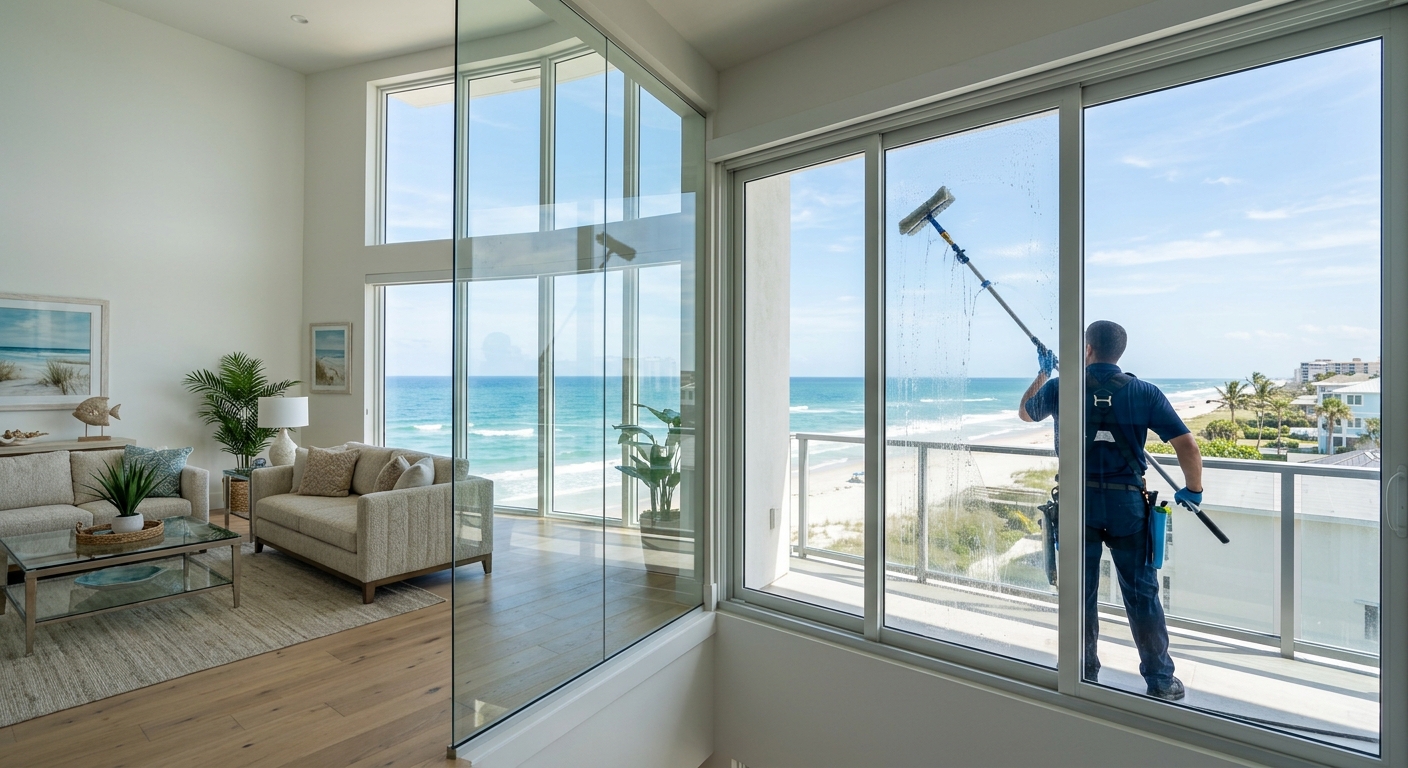
If you live near the ocean, you already know the unique challenges that come with coastal living. That beautiful salt air carries more than just the smell of the sea—it brings tiny, corrosive particles that settle on every surface of your home, slowly eating away at metal, glass, wood, and paint. Add constant sand infiltration to the mix, and you've got a cleaning situation that requires specialized knowledge and dedication.
After years of maintaining hundreds of coastal properties across Florida's beach communities, we've learned exactly what works—and what doesn't—when it comes to protecting homes from salt air damage. This isn't your typical cleaning advice. We're sharing the specific techniques, products, and schedules that actually prevent the costly deterioration we see in neglected coastal homes.
In this guide, you'll learn how salt air actually damages your home at a molecular level, which areas need the most attention, the exact cleaning frequency required for different distances from the ocean, and the products that truly make a difference. Let's dive in.
Understanding How Salt Air Actually Damages Your Coastal Home
Before we talk about cleaning solutions, you need to understand what you're fighting. Salt air isn't just an aesthetic nuisance—it's a chemical process that accelerates material breakdown in specific, predictable ways.
Once salt particles settle on surfaces, they set off a chain reaction that rapidly damages materials. Salt acts as an electrolyte, increasing the conductivity of moisture on metal surfaces. This speeds up electron transfer, leading to faster rust formation and pitting. In coastal areas, visible corrosion can appear in just months, whereas similar damage might take years to develop in inland locations.
Here's what makes it worse: salt is a desiccant, which means it pulls moisture out of materials. On a coastal property, salt air works its way into every crack and crevice. When the water evaporates, the salt remains behind, forming crystals that expand and put pressure on surfaces. This is why you see paint bubbling, wood warping, and metal fasteners failing prematurely.
The Distance Factor: How Far Does Salt Air Really Travel?
Many homeowners assume that salt air only affects waterfront properties, but the data tells a different story. According to the Galvanizers Association, the rate of corrosion from salt air extends 30 to 50 miles inland. In Florida specifically, the National Atmospheric Deposition Program measured salt deposits of up to 860 mg per square meter, showing deep penetration of coastal salt deposits.
We break down risk zones this way based on our experience in South Florida:
- Within ½ to 1 mile of the ocean: This is the danger zone. Homes here require marine-grade metals, weekly exterior rinses, and aggressive corrosion prevention. Salt particles travel easily with prevailing breezes, and over 30% of households in this zone face salt-related damage annually.
- 1 to 3 miles inland: Salt exposure is lighter but still accumulates over time. Exterior metal components, HVAC systems, and window frames age noticeably faster than in non-coastal areas. Bi-weekly to monthly cleaning is essential.
- Beyond 3 miles: Salt air becomes less of a defining factor, though you'll still notice more corrosion than truly inland properties.
One of the most eye-opening statistics we share with clients: metal corrosion from salt air can cut component lifespans by 10-15 years. That's a significant financial impact when you're talking about HVAC systems, railings, roofing materials, and structural fasteners.
Creating Your Coastal Cleaning Schedule: Frequency Matters More Than Intensity
Here's what most homeowners get wrong about cleaning tips coastal homes salt air Florida residents need: they wait too long between cleanings, then try to make up for it with aggressive methods that can damage surfaces. Salt accumulation is a continuous process, which means your cleaning schedule needs to be proactive, not reactive.
Based on hundreds of properties we maintain, here's the frequency that actually prevents damage:
Weekly Tasks (All Coastal Homes)
- Rinse exterior windows, doors, and glass surfaces with fresh water
- Wipe down metal door handles, railings, and light fixtures with a damp microfiber cloth
- Vacuum entryways with a HEPA filter vacuum to remove tracked-in sand and salt
- Damp-mop all hard floors, focusing on areas near exterior doors
Bi-Weekly to Monthly Tasks (Within 1 Mile of Ocean)
- Hose down all exterior siding, starting from the top and working down
- Clean exterior light fixtures and check for corrosion on metal components
- Wipe down stainless steel appliances with vinegar solution
- Check and clean window tracks and seals for salt accumulation
Quarterly Deep Cleaning (All Coastal Homes)
- Professional pressure washing of exterior surfaces, including siding, decks, and walkways
- Clean refrigerator condenser coils with salt-safe products
- Inspect and clean HVAC outdoor units
- Deep clean all windows inside and out with specialized salt-removing solutions
Seasonal Professional Maintenance
For properties within five miles of the ocean, we recommend professional cleaning at least twice a year. Spring cleaning removes winter salt buildup, which is often worse than summer accumulation because storms carry more salt inland. Fall cleaning prepares your home for the coming storm season and removes the heavy summer accumulation.
Our team sees the difference this schedule makes. Clients who follow this frequency avoid the major corrosion issues that plague inconsistently maintained coastal homes. The time investment is significant, but it's nothing compared to the cost of replacing corroded HVAC systems, refinishing damaged windows, or repainting your entire exterior.
The Best Products and Techniques for Removing Salt Buildup
Not all cleaning products work equally well against salt damage. In fact, some common household cleaners can make the problem worse by leaving residues that trap moisture. Here's what actually works.
For General Salt Removal: Keep It Simple
The most effective solution for regular salt removal is also the simplest: warm water with a small amount of gentle dish soap. We use Dawn or similar pH-neutral dish soaps mixed at about 1 tablespoon per gallon of water. This breaks down salt deposits without leaving harsh chemical residues.
For exterior surfaces, a garden hose with a spray nozzle works perfectly for weekly rinses. The key is consistency—you're preventing accumulation, not trying to remove months of buildup at once.
For Windows and Glass: Vinegar-Based Solutions
Salt is abrasive, and if left on glass for too long, it causes microscopic scratches or etching. Once the glass is etched, the cloudy appearance is usually permanent and requires window replacement—a problem we see far too often in neglected coastal homes.
Our go-to window solution: equal parts white vinegar and water in a spray bottle, applied with a microfiber cloth. The acetic acid in vinegar dissolves salt crystals without scratching. For heavily affected windows, we apply the solution, let it sit for 2-3 minutes, then wipe clean with a squeegee followed by a dry microfiber cloth.
Pro Tip: Always clean windows on overcast days or when they're in shade. Direct sunlight causes the solution to evaporate too quickly, leaving streaks and not giving the vinegar enough time to dissolve salt deposits.
For Metal Surfaces: Protection Is Better Than Correction
Once metal starts pitting from salt corrosion, you can't reverse it—you can only slow the progression. This makes preventive protection critical. After cleaning metal surfaces with soap and water, we apply products containing lanolin, which are highly effective at preventing rust and can be safely used on a wide range of materials.
For exterior metal railings, hinges, and fasteners, we've had excellent results with marine-grade corrosion inhibitors. These create a microscopic barrier that repels moisture and salt. Products like Boeshield T-9 or CRC Heavy Duty Corrosion Inhibitor typically last 3-6 months outdoors before requiring reapplication.
For stainless steel appliances and fixtures, regular wiping with a dedicated stainless steel cleaner that contains protective oils makes a huge difference. Salt residue on stainless steel doesn't usually cause rust, but it does cause discoloration and pitting that dulls the finish.
For HVAC Systems: This Deserves Special Attention
Your HVAC system is especially vulnerable because salty air gets drawn in and circulated, coating coils and components with corrosive deposits. A neglected HVAC unit in a coastal environment might last just 5-7 years, while proactive maintenance—including corrosion-resistant materials, anti-corrosion coatings, and regular professional service—extends lifespans to 10-15 years.
Change filters monthly, not quarterly, in coastal homes. Standard HVAC filters trap larger particles, but HEPA filters capture the tiny salt particles that cause the most damage. We recommend upgrading to MERV 11-13 filters for coastal properties.
The outdoor condenser unit needs quarterly attention. Gently spray the fins with fresh water from inside out (never use high pressure, which can bend the delicate fins). If you notice salt crust forming on the coils, schedule professional coil cleaning immediately—this isn't a DIY job.
Managing Sand: Prevention Systems That Actually Work
Salt air is invisible, but sand is an in-your-face daily challenge for coastal homeowners. The good news is that sand management is mostly about prevention systems, not constant cleaning.