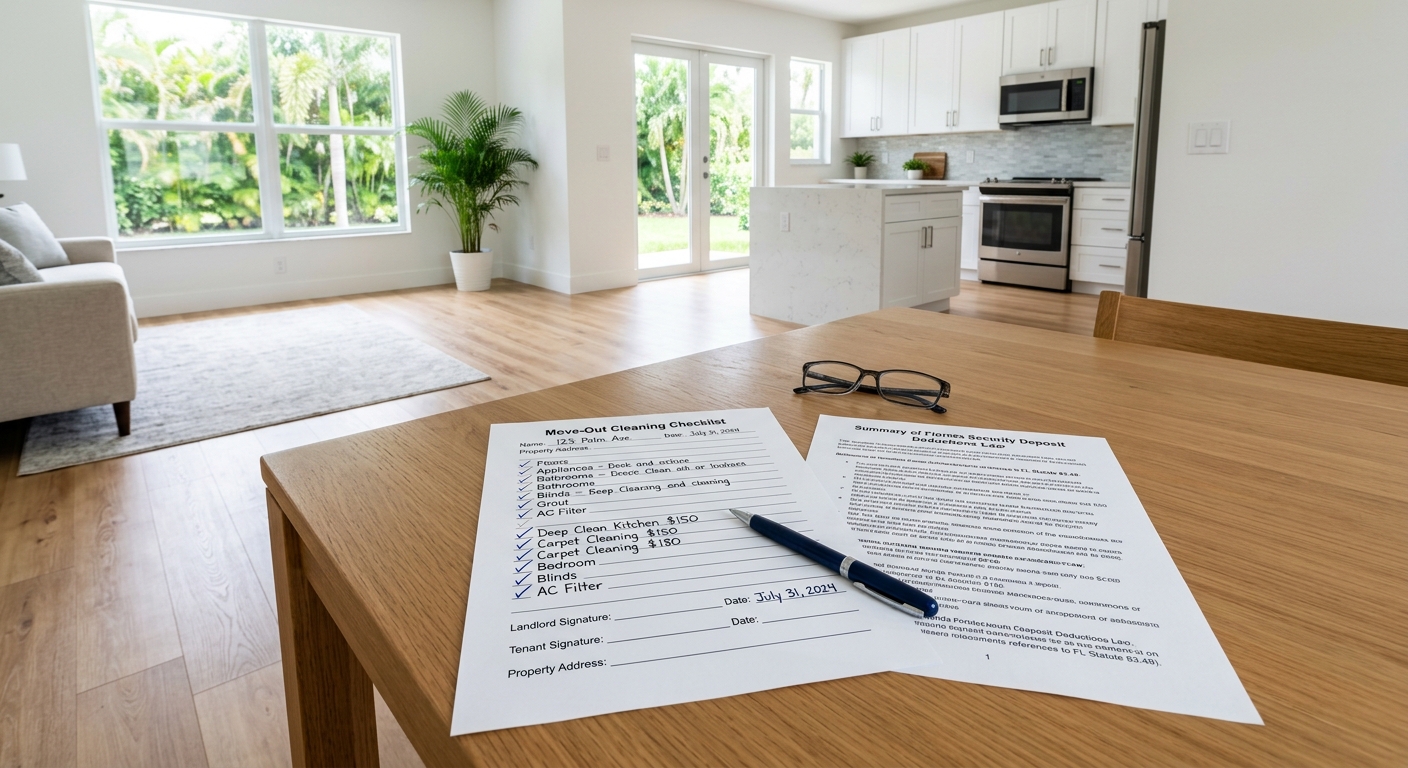
If you have ever moved out of a Florida rental and watched your landlord keep half (or all) of your security deposit for "cleaning," you already know how frustrating this can be. After handling move-out cleanings for hundreds of tenants and landlords across South Florida, we can tell you this: most cleaning deductions we see quoted to tenants are either exaggerated, undocumented, or flat-out illegal under the florida security deposit cleaning deduction law. The good news is that the law is actually more tenant-friendly than most people realize—landlords just don't advertise that part.
In this guide, we're breaking down exactly what Florida Statute § 83.49 allows, what counts as normal wear and tear versus excessive filth, the strict timelines landlords must follow, and what a reasonable cleaning charge actually looks like in dollars and cents. We'll also flag the common mistakes we see landlords (and tenants) make constantly, plus a few pro tips from our own cleaning crews that can save you money and stress.
What Florida Law Actually Says About Security Deposit Deductions
Here's something that surprises a lot of people: Florida Statute § 83.49 does not actually contain a list of things a landlord is allowed to deduct. There's no line item that says "cleaning fee" or "carpet shampoo." Instead, the statute lays out a process, and Florida case law fills in the substance.
Generally speaking, a landlord may deduct from your deposit for:
- Unpaid rent owed at the time you moved out
- Damage to the unit beyond ordinary wear and tear
- Other unpaid obligations that your lease validly makes your responsibility
What a landlord cannot do is charge you for the ordinary aging of the unit through normal, reasonable use, or for routine turnover work that they would have had to do anyway between any two tenants. That last part is the crux of most cleaning deposit disputes, and it's where the florida security deposit cleaning deduction law gets misunderstood or misapplied by landlords who assume any mess equals a valid charge.
The Cleaning Deduction Rule: What's Actually Deductible
This is the single biggest misconception we run into, both from tenants who assume they'll lose their whole deposit over a few dust bunnies, and landlords who think any cleaning bill is fair game. Here's the real rule.
General cleaning—wiping counters, vacuuming, mopping floors, dusting shelves—is a normal operating cost of running a rental property. It cannot be charged to a departing tenant, full stop. Every unit needs some baseline cleaning between tenants, and Florida courts treat that as the landlord's cost of doing business, not tenant damage.
Where it changes is when a tenant leaves the unit excessively dirty, well beyond what normal turnover cleaning would address. Think grease-caked stovetops, mold growth from neglect, pet waste ground into carpet, or trash left behind in multiple rooms. In those situations, a landlord can deduct for professional cleaning that goes beyond standard turnover work.
Some leases also specify a flat cleaning fee upfront. If your lease clearly states a cleaning fee as a condition of the tenancy, that provision is generally enforceable on its own terms—separate from the wear-and-tear analysis. Always read your lease before you sign, and again before you move out.
Pro Tip: Landlords often photograph a messy unit the day after move-out, before they've done a single sweep, and use those photos to justify a huge "cleaning" line item. If you're a tenant, take your own dated, timestamped photos of every room right after you finish cleaning—not before. That timestamp is your best defense if a dispute ever goes to court.
Normal Wear and Tear vs. Excessive Dirt: Where's the Line?
We get asked this constantly, and honestly, it's the question that decides most deposit disputes. Florida courts generally treat the following as normal wear and tear, meaning it cannot be deducted:
- Faded paint from sunlight or age
- Small nail holes from picture hanging
- Traffic-pattern wear on carpet in hallways and living areas
- Minor scuffs on baseboards or walls
- Light dust buildup or a need for routine mopping and vacuuming
On the other hand, deductible damage typically includes:
- Large holes in drywall beyond normal picture-hanging
- Pet urine stains or burn damage embedded in carpet
- Broken fixtures, cabinets, or appliances
- Extreme filth requiring specialized equipment—think biohazard-level grime, mold colonies, or hoarding-level buildup
Two Broward County court decisions, Burley v. Mateo and Smith v. Niederriter (reported at 18 Fla. L. Weekly Supp. 624a and 1051a, 2011), aren't binding statewide precedent, but they're a solid illustration of how Florida judges tend to draw this line in practice. Both cases reinforced that ordinary aging and cosmetic issues don't qualify as tenant damage, no matter how annoyed the landlord is about repainting.
The Strict Timelines Every Landlord Must Follow
Even if a landlord has a legitimate cleaning claim, they can lose the right to enforce it by missing Florida's deadlines. This is where a lot of landlords—especially small, self-managing ones—slip up.
- 15 days: If the landlord does not intend to make any claim against the deposit, they must return the full deposit (plus interest, if applicable) within 15 days of the tenant surrendering the unit.
- 30 days to notify: If the landlord does intend to keep part of the deposit, they must send written notice by certified mail to the tenant's last known address within 30 days of move-out. This notice must state the dollar amount, the specific reason for the deduction, and it must tell the tenant they have 15 days to object in writing.
- 30 days to remit balance: After that notice period runs (or after resolving any objection), the landlord must send any remaining balance within 30 days.
If a landlord misses these deadlines, they forfeit the right to claim against the deposit and must return the full amount. They can still sue you separately for damages, but whoever loses that lawsuit typically pays the other side's attorney fees—which makes landlords think twice before pursuing a shaky cleaning claim in court.
What a Reasonable Cleaning Deduction Actually Costs
One of the easiest ways to spot an inflated deduction is to compare it against real market pricing. After running cleaning crews across Miami-Dade, Broward, and Palm Beach counties, we can tell you the going rates pretty precisely:
- Standard apartment cleaning: typically $75 to $110
- Move-out cleaning (general): averages around $360, with a typical range of $120 to $420 depending on size and condition
- Professional carpet cleaning: averages $183, with most homeowners paying $123 to $242, or roughly $40 to $125 per room
- Tile and grout deep cleaning: $250 to $700
- Junk or trash removal: $150 to $350 per load
If your landlord is deducting $800 or $1,000 for "cleaning" with no itemized invoice, that's a red flag worth pushing back on. Legitimate deductions should be based on actual, documented costs—not a number a landlord picked because it sounded reasonable. Courts specifically look for inspection reports, dated photos, and itemized invoices before they'll uphold a cleaning charge above the normal turnover range.
2024–2025 Legislative Updates You Should Know About
Florida's landlord-tenant law has shifted recently, and it's worth knowing the current landscape:
- House Bill 133 created a statutory alternative under Florida Statute § 83.491, allowing landlords to charge a monthly non-refundable fee instead of a traditional refundable deposit.
- As of July 1, 2024, landlords must give 30 days' written notice (up from 15) to terminate a month-to-month tenancy.
- Florida Statute § 83.425 (effective July 1, 2023) preempts local governments from capping or separately regulating security deposits—state law controls statewide.
- Florida still has no statutory cap on how much a landlord can charge as a security deposit, though most listings we see across South Florida run one to two months' rent.
- If a landlord holds your deposit via surety bond rather than a separate account, they owe you 5 percent simple annual interest on that amount.
What Most People Get Wrong About Cleaning Deductions
After sitting through more move-out walkthroughs than we can count, here are the mistakes we see over and over:
- Tenants assume any mess means they'll lose the deposit. In reality, routine dirt and dust from normal living isn't chargeable at all.
- Landlords assume they can charge for repainting and standard cleaning between every tenant. Unless the lease specifically shifts that cost, it's on them.
- Nobody documents anything. Move-in photos, move-out photos, and itemized invoices are the entire ballgame if a dispute ends up in small claims court.
- Tenants clean right before handing back keys but never photograph it. Without proof, your clean unit and the landlord's "dirty" unit claim carry equal weight—which usually favors whoever has documentation.
- Landlords quote a flat "cleaning fee" with no receipt. Under the florida security deposit cleaning deduction law, arbitrary numbers without documentation are not enforceable.
How to Protect Your Deposit Before You Move Out
If you want your full deposit back, don't leave it to chance. Here's the approach we recommend to every tenant we've ever worked with:
- Pull out your move-in inspection report or photos if you have them, and compare current conditions room by room.
- Clean methodically: kitchen and bathrooms first (these generate the most disputes), then floors, then walls and baseboards last.
- For grease and grime on stovetops and range hoods, we like Bar Keepers Friend over generic all-purpose sprays—it cuts baked-on grease without scratching stainless steel, and it handles hard water spots on faucets in one pass.
- For carpet stains or lingering pet odor, renting a machine like a Rug Doctor for the day (roughly $30 to $50 plus cleaning solution) is far cheaper than letting a landlord hire a professional carpet cleaner and deduct $150 to $250 from your deposit.
- Photograph every room in good lighting immediately after cleaning, including close-ups of any pre-existing damage you didn't cause.
- Keep copies of all correspondence with your landlord, and send your forwarding address in writing so the certified mail requirement can't be used against you.
If a full move-out clean feels like too much on top of packing and coordinating movers, this is exactly the kind of job our move-out cleaning service is built for. We know what landlords and property managers are looking for during a walkthrough, because we've done hundreds of them.
Frequently Asked Questions
Can a Florida landlord charge me a flat cleaning fee no matter what?
Only if your lease clearly specifies a cleaning fee as a term of the tenancy. Without that lease language, cleaning charges must be tied to documented, excessive dirtiness beyond normal turnover—not a routine flat fee.
How long does a landlord have to return my security deposit in Florida?
If they're not making any claim, 15 days from move-out. If they intend to deduct anything, they have 30 days to send you written notice by certified mail explaining the amount and reason, and you then have 15 days to object.
What happens if my landlord misses the 30-day notice deadline?
They forfeit their right to keep any part of the deposit for damages or cleaning and must return the full amount. They could still sue you separately, but the losing party in that suit typically covers the other side's attorney fees.
Is there a cap on how much a Florida landlord can charge for a security deposit?
No. Florida does not impose a statutory cap, and as of July 1, 2023, local governments are preempted from creating their own caps. Most listings across Miami-Dade, Broward, and Palm Beach counties run one to two months' rent, but there's no legal ceiling.
Bottom Line on Florida Security Deposit Cleaning Deductions
Understanding the florida security deposit cleaning deduction law comes down to one key distinction: routine cleaning and normal wear and tear are the landlord's cost of doing business, while excessive filth beyond standard turnover can legitimately be deducted—if it's documented with photos and itemized invoices. Know the timelines, know the difference between grime and damage, and document everything before you hand over the keys.
And if you'd rather not spend your last weekend in an apartment scrubbing baseboards and stressing over stove grease, our team handles move-out cleanings across Miami, Fort Lauderdale, and Boca Raton every week. Check out our house cleaning cost guide to see how our move-out pricing compares before your next lease ends.