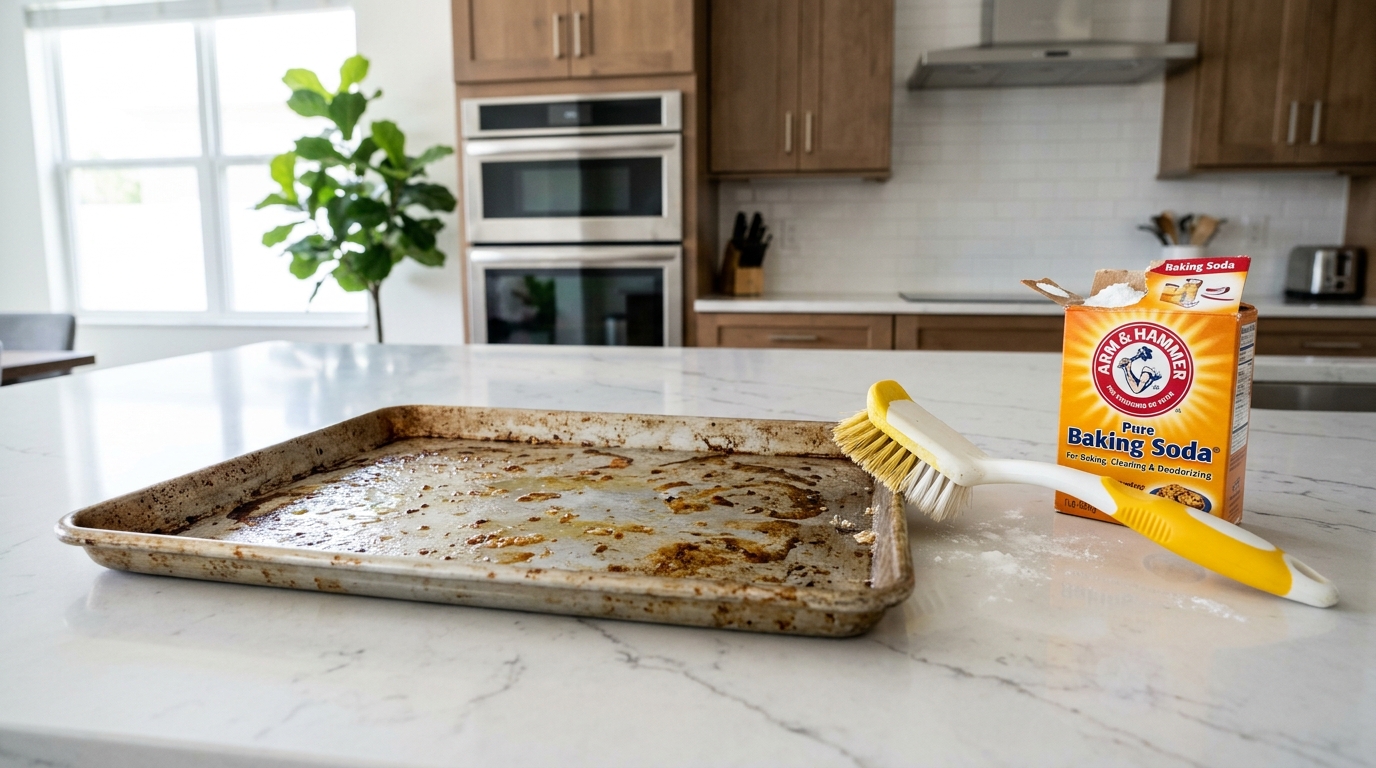
You pull a tray of roasted vegetables out of the oven, and the pan underneath looks like it has been through a small fire. The brown, sticky, slightly shiny layer won't budge with a sponge, and every time you wash it, it seems to come back. If you've been wondering how to clean baking sheets that have years of baked-on grease, the good news is that you almost never need brute force.
In this guide we'll cover why that film gets so stubborn, how to identify your pan's material before you scrub, and three step-by-step methods that work. We'll also cover what not to do, because a few popular tricks can ruin a good pan. Plenty of what follows comes from cleaning kitchens in Florida homes every week.
Why Baked-On Grease Is So Hard to Remove
Fresh grease washes off with dish soap. Baked-on grease doesn't, because heat changes it. Oil that is heated again and again on the same metal bakes into a hard, varnish-like layer that bonds to the surface.
That layer is what you see as brown or black patches, a sticky tan film, or a rough texture along the edges. Soap alone can't dissolve it. You need something that softens it (heat, time and an alkaline or oxidizing cleaner) plus something gentle enough to lift it without scratching.
One more thing: some of that darkening is just discoloration. Many cooks swear by a well-used, darkened pan because it browns food evenly. If the surface is smooth and not sticky or flaky, it is clean enough to cook on, even if it isn't pretty.
Step One: Identify Your Pan Before You Pick a Method
This is the step most guides skip, and it's where pans get damaged. The right method depends on the material.
Bare aluminum (most common)
A light gray, matte pan is usually bare aluminum. It heats quickly and evenly, and it is the standard for home baking. It is also sensitive. Nordic Ware's use and care guidance for its natural aluminum bakeware is the place to check for your own pan. In general, makers of aluminum pans steer you toward hand washing instead of the dishwasher, and away from harsh cleaners. Strong alkaline products can darken aluminum.
Stainless steel or steel-lined pans
Shiny, heavier and often slightly silver, not gray. These tolerate more aggressive cleaning, including powdered cleansers made for stainless.
Nonstick or coated pans
Dark gray or black, smooth, with a slick feel. Skip abrasives completely. No scouring powders, no steel wool, no oven cleaner. Scratches and chemical damage are permanent, and a damaged coating isn't something you want near your food.
Quick test
If you aren't sure, start with the gentlest method below: a hot soak with dish soap. If that does nothing after an hour, move up to the paste. Escalate one step at a time.
What You'll Need
- Dish soap with a degreasing formula. It breaks down the unbaked oil so the harder layer is easier to reach.
- Baking soda. A mild alkaline cleaner and a gentle abrasive, which is why it shows up in nearly every method.
- 3% hydrogen peroxide (the brown drugstore bottle). It adds oxidizing power to the paste and helps lift discoloration.
- A non-scratch scrub pad or nylon brush and a plastic or silicone scraper. Metal scrapers gouge soft aluminum.
- Rubber gloves. Warm water and baking soda dry out your hands more than you'd expect.
- A microfiber towel for fully drying the pan afterward.
Several major kitchen publications have tested variations on these exact ingredients. Taste of Home compared four methods for cleaning baking sheets, and The Kitchn tested five ways on gunky, seasoned pans. The common thread across most of them is the same: soak or paste first, then scrub gently.
How to Clean Baking Sheets: Three Methods That Work
Method 1: The hot soapy soak (lightly stained pans)
- Plug the sink or use a tub large enough to lay the pan flat. Fill it with the hottest tap water you can handle.
- Squirt in a generous amount of degreasing dish soap, a tablespoon or two.
- Submerge the pan and let it sit for at least 30 minutes. For a pan that has been sitting dirty, give it 1 to 2 hours.
- Scrub with a non-scratch pad, working in small circles.
- Rinse and dry completely.
This is the safest method for every pan type, including nonstick. It won't fix years of buildup, but it will clear the top layer and show you what you're really dealing with.
Method 2: Baking soda and hydrogen peroxide paste (the workhorse)
- Wash off any loose crumbs and fresh grease first with warm soapy water. Don't dry the pan.
- Sprinkle a thick, even layer of baking soda across the stained areas. Be generous.
- Drizzle hydrogen peroxide over the baking soda until it forms a wet, spreadable paste. You're after the consistency of wet sand, not soup.
- Spread the paste with a spoon or your gloved fingers, making sure it covers the edges and corners where grease collects.
- Let it sit. For moderate staining, 1 to 2 hours is enough. For heavy buildup, leave it overnight.
- Scrub with a non-scratch pad or nylon brush. The paste should have darkened and loosened the residue. Use a plastic scraper for stubborn spots.
- Rinse thoroughly, wash with dish soap to remove any film, and dry.
A note on bare aluminum: baking soda is alkaline, and extended contact can leave aluminum looking duller or darker. It's typically a cosmetic change, and it doesn't affect how the pan cooks. If you want to be careful, shorten the sit time to an hour, then rinse well. On stainless steel, you can leave it overnight without worry.
Pro Tip: Warm the pan before you apply the paste. Run it under hot water for a minute, or leave it in a barely warm oven (about 200°F) for five minutes, then let it cool enough to handle. Heat opens up the baked-on layer and the paste works noticeably faster. Never put cold paste on a hot pan, and never use a glass-lidded or wet pan in an oven that is hot.
Method 3: Powdered stainless cleanser (steel pans only)
Powdered cleansers such as Bar Keepers Friend are made for stainless steel and are good at removing stains and discoloration. Check the label for your pan's material before you use one. They are not meant for nonstick, and they can dull softer metals.
- Wet the pan and sprinkle a small amount of powder across the stain.
- Make a loose paste with a damp sponge.
- Let it sit for about a minute (the label's directions take priority over our guess).
- Scrub gently in the direction of the metal's grain, then rinse well.
Wear gloves, rinse thoroughly, and wash again with dish soap afterward so no powder residue ends up on your next batch of cookies.
When the Pan Still Isn't Clean: The Last Resort
If you have a stainless or steel pan that is truly caked, the next step up is a lye-based oven cleaner. It works, but it is corrosive.
- Never use it on aluminum or nonstick. Lye reacts with aluminum and will pit and blacken it.
- Work in a ventilated area, with gloves and eye protection.
- Follow the product label's directions for contact time, and rinse repeatedly.
- Keep it away from your food surfaces, and wash the pan with soap and plenty of water afterward.
We'd save this for pans you're ready to retire anyway. Most of the time, a second round of Method 2 and a little patience does the job without the risk. If you're dealing with a baked-on oven as well, our guide to cleaning your oven without harsh chemicals uses a similar approach.
The Dishwasher Question
It's tempting to run a greasy sheet pan through the dishwasher. We don't recommend it for most pans. Dishwasher detergents are strongly alkaline, and Nordic Ware's care guidance for its natural aluminum bakeware directs you to wash by hand. Bare aluminum can come out chalky, gray or streaked, and nonstick coatings can wear faster.
Stainless steel pans handle the dishwasher better, but even then it won't remove baked-on grease. It just bakes a film of detergent over it. Hand wash first.
Common Mistakes That Make Baking Sheets Worse
- Mixing cleaners. Don't combine hydrogen peroxide with vinegar in the same container. The two react to form a corrosive acid. Use them separately, if at all, and rinse in between. Our list of cleaning products you should never mix covers the combinations to avoid.
- Scrubbing with steel wool. It scratches aluminum and nonstick coatings, and the scratches hold even more grease next time.
- Using oven cleaner on the wrong pan. Aluminum and nonstick should never see it.
- Soaking for days. A soak that sits too long can leave a gray film on aluminum. Overnight is the limit for most pans.
- Putting the pan away damp. This matters more in humid climates. In South Florida, steel pans can start to rust if moisture lingers, and any damp storage spot can smell musty. Dry every pan by hand, then let it air out for a few minutes before stacking.
- Expecting it to look brand new. A used pan will have some patina. The goal is a pan that isn't sticky, flaky or smoking at 400°F.
How to Keep Baking Sheets From Getting This Bad Again
Once you've done the hard work, a few habits keep the next cleanup to five minutes.
- Line the pan. Parchment paper or a silicone baking mat catches most of the grease. Parchment is rated for typical baking temperatures, but check the box for its maximum, because it can scorch near the top of the range.
- Use a rack for fatty foods. Set a wire rack inside the pan when roasting bacon or chicken thighs so the fat drips down instead of baking onto the metal.
- Soak right away. While the pan is still warm, fill it with hot water and a squirt of dish soap. Dinner can finish before you come back to it.
- Wash after every use. Thin, fresh residue washes away in seconds. It's the stuff that gets reheated over and over that turns into varnish.
- Don't stack wet pans. Moisture trapped between them is a rust risk on steel and a source of that stale smell.
Cleaning the sheet pans is a good moment to look at the rest of the kitchen, too. Grease that lands on the pan also lands on the stovetop, range hood and cabinet fronts. Our guides to deep cleaning your kitchen and cleaning greasy kitchen cabinets can help with the rest.
Conclusion
Knowing how to clean baking sheets comes down to three habits: match the method to the metal, let time and a gentle paste do the work, and dry the pan fully. Start with the hot soak, move up to baking soda and peroxide, and keep harsh chemicals for sturdy steel pans only. Most pans recover well, and the ones that don't are still safe to cook on once they're clean.
If you'd rather leave the kitchen to the pros, Catalina Cleaning offers deep cleaning for homes across South Florida, the St. Petersburg area and the Panhandle coast, so you can spend your weekend baking instead of scrubbing.
Frequently Asked Questions
What is the best way to clean baking sheets with baked-on grease?
For most pans, a paste of baking soda and 3% hydrogen peroxide left on for one to several hours, then scrubbed with a non-scratch pad, gives the best balance of power and safety. Start with a hot soapy soak if the buildup is light.
Can I use vinegar and baking soda to clean a baking sheet?
You can, but it isn't the strongest option. The two neutralize each other, leaving mostly salty water and a bit of fizz. Baking soda with hydrogen peroxide, or baking soda paste on its own, usually works better on baked-on grease.
Is it safe to use Bar Keepers Friend on baking sheets?
It's meant for stainless steel and similar surfaces, so it can work on steel pans. Don't use it on nonstick pans, and test a small spot first on aluminum, since abrasive or acidic cleansers can dull it. Always follow the label.
Why do my aluminum baking sheets turn gray or dark after cleaning?
Alkaline cleaners, including strong dishwasher detergents and long baking soda soaks, can oxidize bare aluminum. The discoloration is usually cosmetic and doesn't affect cooking. To limit it, hand wash, keep soak times short, and rinse and dry well.
Can I put baking sheets in the dishwasher?
Check the manufacturer's care instructions. Nordic Ware's guidance for natural aluminum bakeware is to wash by hand, and we'd do the same for aluminum and nonstick. Stainless steel pans are usually fine in the dishwasher, but it won't remove baked-on grease by itself.