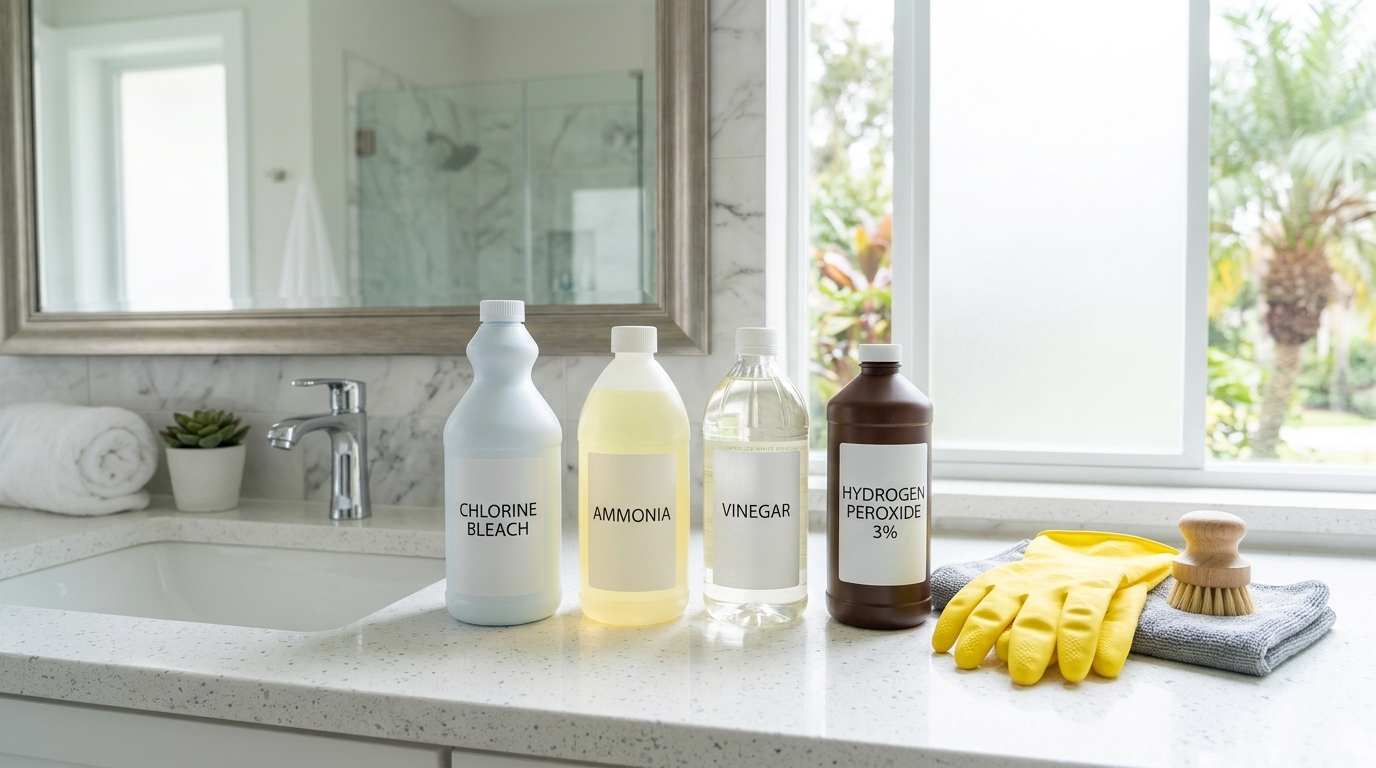
You're scrubbing a shower that still looks gray. The bleach is under the sink, the vinegar spray is on the counter, and a little extra power sounds like a good idea. It isn't. Knowing which cleaning products you should never mix takes about five minutes to learn and can spare you a trip to the emergency room.
In this guide we cover the combinations that create harmful fumes, why Florida homes make the problem worse, and what to reach for instead. You'll also get a simple one-product-at-a-time routine and a plan for what to do if you've already mixed something.
Why Mixing Cleaners Is a Bigger Deal Than It Sounds
Most people think of poisonings as a kid-and-medicine-cabinet problem. Cleaning accidents are just as ordinary. According to the 2024 National Poison Data System report from America's Poison Centers, poison centers logged 2,418,426 closed encounters in 2024, including 2,092,689 human exposures. Human exposure cases rose 0.578% from 2023.
Those numbers cover every kind of substance, not just cleaners, so don't read them as a cleaning-product count. The severity trend is still worth knowing. The 2022 report found that more-serious outcomes (moderate, major or death) have risen 4.41% a year since 2000. The same report's breakdown by location shows most exposures happen in residences, and workplace exposures were only 1.93% of cases.
In other words, this is a kitchen-and-bathroom problem, not a factory problem. And it usually starts with good intentions: someone wants a stronger clean and combines two products that each work fine alone.
Cleaning Products You Should Never Mix: The Core Combinations
Here are the pairs to keep apart. Chemistry sources agree on these, and the CDC's guidance on bleach is clear. CDC's Environment account says that when removing mold, you should never mix bleach with ammonia or other household cleaners because the mix produces dangerous, toxic fumes.
| Never combine | What can form | Where you'll find the culprits |
|---|---|---|
| Bleach + ammonia | Chloramine gas | Many glass cleaners, some multi-surface sprays, cat-litter area cleaners |
| Bleach + vinegar or other acids | Chlorine gas | Vinegar, toilet-bowl cleaners, some tile and rust removers |
| Bleach + rubbing alcohol | Chloroform and other harmful compounds | Rubbing alcohol, some sanitizing sprays |
| Hydrogen peroxide + vinegar (in one container) | Peracetic acid, which is corrosive | Brown-bottle peroxide, white vinegar |
Bleach and ammonia
This is the classic. Ammonia is the hidden ingredient in a surprising number of window and glass cleaners, so you can make this mix without ever picking up an ammonia bottle. If you cleaned a mirror with a blue spray and then hit the same spot with a bleach-based bathroom cleaner, you may have made chloramine gas right there on the surface.
Read the ingredient list on anything you spray before you bring bleach into the room. If you see ammonia, ammonium hydroxide, or a smell that stings your nose, keep it far from bleach.
Bleach and vinegar (or any acid)
Bleach plus an acid releases chlorine gas. Vinegar is the one people reach for, but many toilet-bowl cleaners and some descalers are acidic too. That makes the bathroom the highest-risk room, because it's small, often has a fan that doesn't work well, and is where people layer products on stubborn stains.
You'll see blogs claim this mix is instantly deadly in ordinary home amounts. Poison-center guidance is more measured. A small accidental mix usually causes irritation of the eyes, nose, throat and lungs, but that is still dangerous. A closed room, a large amount, or someone with asthma raises the stakes. We'd rather you skip the argument and never combine them.
Bleach and rubbing alcohol
This one surprises people. Bleach and alcohol can form chloroform and other harmful compounds. It tends to happen when someone wipes a surface with an alcohol-based sanitizer and then follows with bleach, or the other way around. Pick one and finish the job with that product.
Hydrogen peroxide and vinegar
Each is a perfectly reasonable cleaner alone. Mixed together in one bottle, they form peracetic acid, which can irritate or burn skin, eyes and lungs. Never store the two together in the same spray bottle. If you want to use both on one job, use one, wipe it off, rinse the surface with water, and let the area air out before using the other. Honestly, it's simpler to choose one.
Two bleach-containing or two drain products
Check labels for "bleach" or "sodium hypochlorite" on tub, toilet and mildew products. Stacking two products from different brands can mean stacking incompatible ingredients. The rule that never fails: if the label doesn't tell you to combine it with something, don't.
Why This Matters More in South Florida Homes
Miami-Dade and Broward are humid most of the year, and that's where the temptation starts. Pink or black spots in the shower, mildew on window tracks, and a musty smell near the AC vent all make people grab bleach and then reach for a second product when the first one doesn't win. We'd call that the Florida cleaning reflex.
The other half of the equation is air. Closed, AC-sealed condos and apartments with a single small bathroom fan hold fumes longer than a house with cross-breezes. That's our reasoning from working in homes like these, not a measured finding, but it's why we're so firm about opening the door and running the fan.
Stone is a second Florida factor. Travertine, marble and terrazzo are common here, and vinegar can etch natural stone. So the "safe, natural" swap many people reach for can quietly damage a bathroom floor or countertop. For mold-specific steps, see our guide on removing mold and mildew in South Florida.
What to Use Instead: Safer Swaps That Still Work
The goal isn't to avoid every strong product. It's to use the right one by itself, for the right job. Here's how we'd match jobs to products.
| Job | Use this | Why |
|---|---|---|
| Greasy stovetop, kitchen counters | Dish soap and warm water | Soap breaks up grease. No fumes and no chemistry to worry about. |
| Everyday bathroom surfaces | A product labeled EPA Safer Choice, used alone | Safer Choice products are designed to meet stricter ingredient criteria. |
| Light stains and freshening | 3% hydrogen peroxide, used by itself | It's a mild oxidizer that works on many surfaces without chlorine. |
| Killing germs after a cold or stomach bug | An EPA-registered disinfectant, followed for the full contact time | Registration means it has been tested for the claims on the label. |
| Mold on hard surfaces | Detergent and water first, then one disinfectant as the label directs | Removing the growth matters more than adding a second chemical. |
Don't count on vinegar and baking soda to disinfect
Vinegar and baking soda are fine for deodorizing and light scrubbing, but they are not EPA-registered disinfectants. If you need to disinfect, look for a registered product (EPA's List N is the place to check) and follow the label's contact time. That's the number of minutes the surface has to stay visibly wet. Wiping it off in 10 seconds doesn't count.
We cover gentle options in more depth in our roundup of the best natural cleaning products. If you have dogs or cats, our guide to pet-friendly cleaning products is worth a read too.
A Safe Cleaning Routine: One Product at a Time
This is the habit that prevents almost every accident on the list above. It takes no extra equipment.
- Open a window or door, and run the exhaust fan. Do this before you pick up a bottle, not after you smell something.
- Read the label. Look for ammonia, bleach (sodium hypochlorite) and acids. Note the contact time.
- Start with soap and water. Scrub off soil first. Dirt eats up disinfectant and tempts you to add more product.
- Apply one product. Let it sit for the label's contact time, then wipe.
- Rinse the surface with plain water. This clears residue so the next product doesn't meet the last one.
- Let it dry or air out before using anything else in the same spot.
- Keep products in their original containers. If you must use a spray bottle, label it with the contents and never reuse one that held something else.
Pro Tip: Take a permanent marker and write BLEACH on the lid of any bleach-based product and AMMONIA on anything that contains it, then store them on opposite sides of the cabinet or in different rooms. In our experience, most mix-ups happen when someone grabs a spray without looking, and a big label on the lid catches that moment.
If You've Already Mixed Something
Don't try to fix it. Don't pour something else on top to neutralize it, and don't stay to ventilate the room.
- Leave right away. Get yourself, children and pets into fresh air. Take the door with you and shut it behind you if you can do so without breathing in.
- Call poison control. America's Poison Centers says the service is free, confidential and open 24/7. The national number is 1-800-222-1222.
- Call 911 if anyone has trouble breathing, chest pain, severe coughing, or is confused or fainting.
- Return only when the room has aired out and poison control says it's fine. Then clean up with gloves and water.
Common Mistakes We See
- Assuming a "natural" mix is automatically safe. Peroxide and vinegar are both natural-sounding, and together they form a corrosive acid.
- Layering products to boost power. A stronger clean comes from soap, scrubbing and contact time, not from stacking chemicals.
- Skipping the rinse. Residue from product one is the ingredient in the next reaction.
- Cleaning in a sealed bathroom. A shut door and a weak fan trap fumes. Open the door.
- Mixing in one bottle "to save time." Some pairings also build pressure in a closed container. Even baking soda and vinegar, which isn't toxic, can burst a sealed bottle.
- Not reading the ingredients on glass cleaner. Ammonia hides in everyday sprays.
- Using vinegar on stone. It can dull travertine, marble and terrazzo.
The Bottom Line on Cleaning Products You Should Never Mix
The short list is easy to remember: bleach stays away from ammonia, acids and alcohol, and peroxide stays out of the same bottle as vinegar. Beyond that, use one product at a time, rinse between them, and keep the air moving. Soap and water does more of the work than most people expect.
If you'd rather leave the scrubbing to the pros, Catalina Cleaning is a family-owned, licensed and insured company serving South Florida, the St. Petersburg area and the Panhandle coast. Our deep cleaning service covers the bathroom grout, shower glass and other trouble spots, and you can request a quote whenever it suits you.
Frequently Asked Questions
Is it safe to mix bleach and vinegar?
No. Bleach plus an acid like vinegar releases chlorine gas. Small accidental mixes usually cause irritation, but they can still be dangerous, especially in a closed bathroom or for someone with asthma. Use one at a time, and rinse the surface with water between them.
Can I mix hydrogen peroxide and vinegar?
Not in the same bottle. Together they form peracetic acid, which is corrosive. If you want to use both on one task, apply one, wipe it away, rinse with water, and let the area air out before using the second.
Does vinegar disinfect?
Vinegar is a useful deodorizer and light cleaner, but it isn't an EPA-registered disinfectant. If you need to kill germs, pick a registered product from EPA's List N and keep the surface wet for the contact time on the label.
What should I do if I accidentally mixed two cleaners?
Get out of the room and into fresh air, bring children and pets with you, and call poison control at 1-800-222-1222. Call 911 for trouble breathing, chest pain or confusion. Don't try to neutralize the mix with another product.
What can I use to clean mold without bleach?
On hard surfaces, start by scrubbing with detergent and water to remove the growth, then use one EPA-registered product exactly as labeled, or 3% hydrogen peroxide used alone. Whatever you pick, don't combine it with another cleaner and keep the room ventilated.