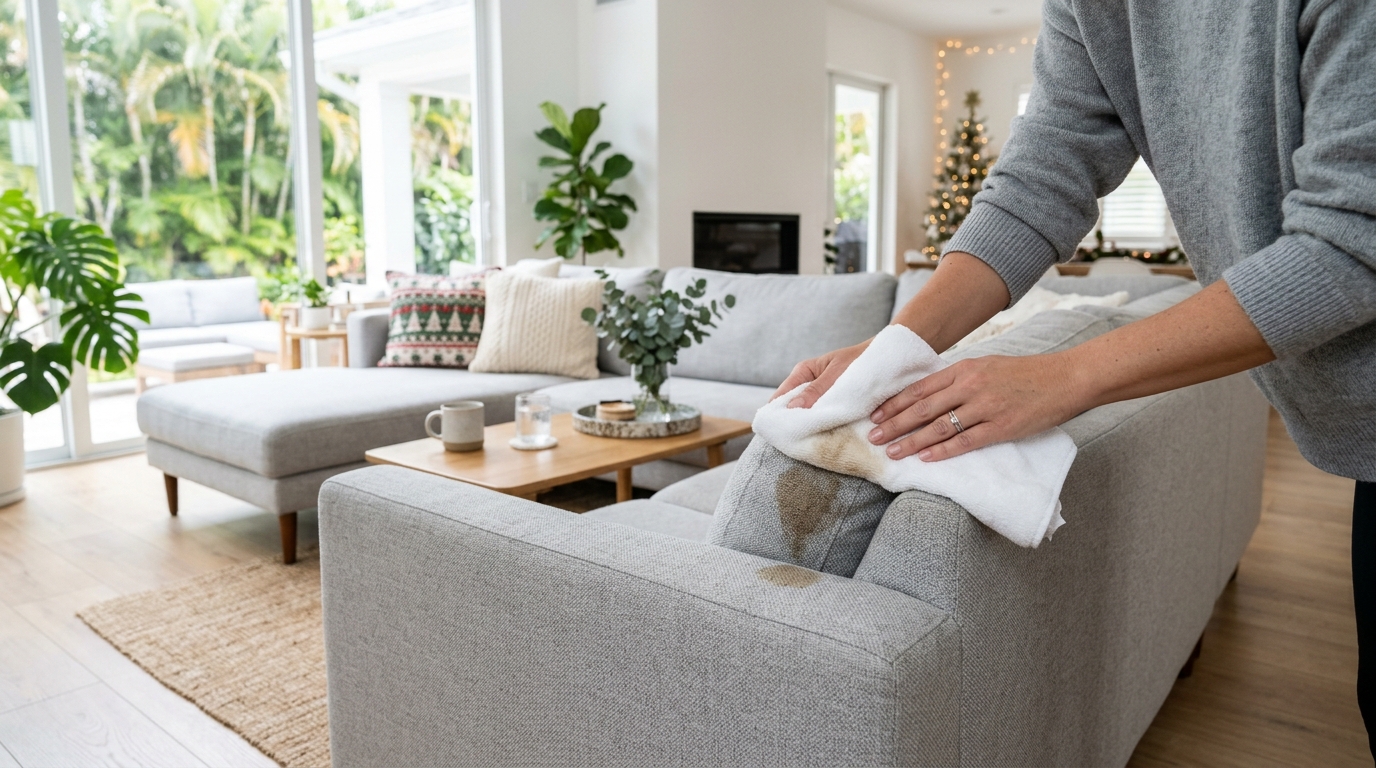
Your guests will spend most of the holiday on your couch. Right now it might have a faint coffee ring, a dog-shaped dent and a smell you've stopped noticing. If you're wondering how to clean a couch without leaving water stains, shrinking the cushion covers or turning velvet into a matted mess, the answer depends almost entirely on what the couch is made of.
In this guide we'll walk through how to read your couch's cleaning code, the right method for each common fabric, how to handle old stains, and how to get everything dry in Florida humidity. We'll also give you a countdown so the couch is fresh well before Thanksgiving on November 26.
Step One: Find Your Couch's Cleaning Code
Before you spray anything, flip a cushion or look under the frame for the manufacturer's tag. Most upholstered furniture carries a one- or two-letter cleaning code. In our experience, this single letter prevents more ruined couches than any product or technique.
According to Frontgate's upholstery care-code guide and the fabric cleaning code explainer from Sailrite, the codes break down like this:
| Code | What it means | What you can use |
|---|---|---|
| W | Water-based cleaning is safe | Mild soap and water, water-based upholstery cleaners |
| S | Solvent only, no water | Water-free solvent cleaners, such as rubbing alcohol or a dry-cleaning solvent |
| W/S (or SW) | Either water or solvent | Mild soap and water or solvent; test first |
| X | Vacuum only | Vacuuming or light brushing; anything more goes to a professional |
Frontgate's guide also lists a W/S/B variation, where B means a diluted bleach solution is acceptable. That code usually shows up on outdoor and performance fabrics, not your average sofa.
No tag? Here's what we do
Tags get cut off. If yours is gone, check the manufacturer's website for your model, or look up your order confirmation. If you still can't find it, put one drop of distilled water on a hidden spot, like the back near the floor. If it leaves a ring or the dye bleeds onto a white cloth, treat the couch as S-code.
How to Clean a Couch: The Basics for Every Fabric
Whatever the fabric, the first 30 minutes look the same. Skipping this prep is why so many DIY jobs end with muddy streaks: you're just pushing wet dust around.
- Remove everything. Pull off cushions, throws and pillows. Dig coins, crumbs and pet toys out of the crevices.
- Vacuum thoroughly. Use the upholstery attachment on every surface, then the crevice tool along seams and where the back meets the seat. Go slowly, in overlapping strokes. South Florida homes collect a lot of fine dust (we wrote about why South Florida homes get so dusty), and much of it settles into upholstery.
- Brush the fabric. A soft-bristle brush lifts embedded hair and loosens dried grime before any liquid touches it.
- Gather white cloths. Use white microfiber or white cotton only. Colored cloths can transfer dye, especially with alcohol.
- Test in a hidden spot. Whatever cleaner you choose, apply it somewhere out of sight, let it dry fully, and check for rings, fading or texture change.
One more rule that applies to every fabric: blot, don't rub. Rubbing frays fibers, spreads the stain and can permanently fuzz the surface.
Cleaning Methods by Fabric Type
The code tells you what's safe. The fabric tells you how to handle it. Here's how we approach the upholstery we see most in Florida homes.
Cotton and linen
Natural fibers look great and breathe well in the heat, but they shrink, water-stain and fade. Many cotton and linen couches are coded W/S, and some linen is S-only, so check first.
- For W or W/S: mix a few drops of clear dish soap into two cups of warm distilled water. Distilled matters here because mineral-heavy tap water can leave its own ring as it dries.
- Dampen a white cloth (wring it until it's barely wet) and blot the stain from the outside in.
- Follow with a second cloth dampened in plain distilled water to rinse out soap. Leftover soap is sticky and attracts new dirt within weeks.
- Blot dry with a clean towel.
Don't toss removable cushion covers in the washing machine unless the tag says you can. Zippers are often there to help the factory stuff the cushion, not to invite laundering. A washed cover can shrink just enough that it never fits again, and it may fade unevenly next to the unwashed arms.
Polyester and microfiber
Microfiber is the fabric families buy for durability, and it's very often S-coded. Water tends to leave obvious rings on it. Our go-to for S-coded microfiber is isopropyl rubbing alcohol.
- Pour rubbing alcohol into a spray bottle and mist the dirty area lightly.
- Scrub gently with a white sponge or soft brush. You'll see grime lift onto the sponge.
- Let it evaporate. Alcohol dries in minutes, which is why it doesn't ring.
- Once dry, brush the fabric in one direction with a soft brush to restore the soft texture.
Alcohol is flammable, so open a window, run a fan and keep candles off until it's fully dry. If your microfiber is coded W, the dish soap method above works too.
Velvet
Velvet comes in cotton, polyester and blends, and the code varies widely. What doesn't vary is the pile, the short raised fibers that give velvet its sheen. Crush them and you get permanent bald-looking patches.
- Vacuum with a soft brush attachment and low suction, following the direction of the nap.
- Spot-clean with the method your code allows, using as little liquid as possible.
- While the spot is still slightly damp, brush the pile gently with a soft brush so it dries upright.
- Skip heavy steam unless the manufacturer specifically approves it. Steam can crush or distort the pile.
Leather and faux leather
Genuine leather usually isn't covered by the W/S/X system. It needs its own care. Do the water test first: put a single drop on a hidden spot. If it soaks in and darkens, you likely have aniline (unfinished) leather, which stains easily and needs a very gentle hand.
- Vacuum seams, then wipe surfaces with a cloth dampened in distilled water.
- Use a pH-balanced leather cleaner, applied to the cloth rather than sprayed on the couch.
- Follow with a leather conditioner. Florida homes run air conditioning most of the year, which dries leather out, and sun through sliding doors makes cracking worse.
- Avoid vinegar, rubbing alcohol, baby wipes and all-purpose sprays. They can strip the finish.
Faux leather (polyurethane or vinyl) is simpler: mild soap and water, wiped and dried. Skip alcohol and harsh solvents, which can crack or peel the coating.
Performance and outdoor fabrics
Performance fabrics are built to resist spills and are common on lanai furniture and family-room sectionals. Many tolerate mild soap and water, and some carry the W/S/B code that allows diluted bleach. Follow the specific manufacturer's instructions, because "performance" covers a lot of different materials.
Silk, wool, and anything coded X
X-coded and delicate fabrics are vacuum and brush only. Spot-cleaning at home risks water rings, dye loss and shrinkage that can't be undone. If an X-coded couch has real stains, a dedicated upholstery cleaner is the right call.
Spot-Treating the Stains You Already Have
Most couches arrive at the holidays with a backlog: last month's coffee, greasy hand marks on the arms, a pet accident. Here's how we tackle them, always within your code.
- Coffee, tea and juice (W or W/S): Dish soap solution, blot, rinse with distilled water, blot dry. Repeat rather than soaking.
- Body oil and grease on arms and headrests: These dark, shiny patches respond well to the solvent approach. On W/S or S fabrics, rubbing alcohol on a white cloth cuts the oil. On W fabrics, a slightly stronger dish soap mix helps.
- Pet urine (W fabrics): Use an enzyme cleaner, which breaks down the odor-causing compounds instead of masking them. Our guide to removing pet stains from carpet covers the same enzyme process. On S-coded fabric, call a pro; water-based enzymes can ring.
- Ink: Dab (don't pour) rubbing alcohol on a cotton swab, only on fabrics that tolerate solvent.
- General odors: On W and W/S fabrics, sprinkle baking soda evenly, leave it at least several hours or overnight, then vacuum thoroughly. Test on dark fabric first, since it can leave a white haze if not fully removed.
Watch for wicking
Sometimes a stain you removed reappears a day later. That's wicking: residue deep in the cushion foam travels up to the surface as it dries. It's not a failure, just a sign you need a second, lighter pass. This is exactly why we recommend cleaning a week or more before guests, not the night before.
Pro Tip: After treating a stain, fold a dry white towel into a thick square, lay it on the damp spot and set something heavy on top, like a stack of books, for an hour. The towel pulls moisture and dissolved residue up and out of the cushion instead of letting it settle back into the foam, which cuts down on wicking and speeds drying.
Drying Your Couch in Florida Humidity
In a dry climate, a damp cushion is fine by morning. In Miami, St. Pete or Pensacola, a soaked cushion in a closed-up room can start smelling musty within days. Drying is half the job here.
According to the EPA, indoor humidity should stay below 60 percent, ideally between 30 and 50 percent, to discourage mold growth. The EPA also advises drying water-damaged materials within 24 to 48 hours. A cleaned couch isn't water damage, but the same logic applies to dense foam that stays wet.
- Use less water. Damp, never soaked. This is the biggest factor.
- Keep the AC running at your normal setting. It's pulling moisture out of the air as it cools.
- Add airflow. Turn on the ceiling fan and aim a box fan at the couch.
- Run a dehumidifier in the room if you have one, especially in a ground-floor unit.
- Stand cushions on edge so air reaches both sides.
- Don't put cushions in direct sun on the lanai. UV fades fabric fast, and outdoor humidity may slow drying anyway.
If a cushion still smells sour after two days, moisture is likely trapped in the foam. Our posts on humidity and mold in Florida homes explain what to do when that musty smell won't leave.
A Holiday Couch-Cleaning Countdown
Thanksgiving falls on November 26 this year. Working backward gives you time for drying and a second pass:
- Two weeks out (by Nov 12): Find the code, vacuum thoroughly, and test your cleaner in a hidden spot.
- About 10 days out (Nov 14–16): Do your main spot cleaning and odor treatment. Dry it fully.
- About 5 days out (Nov 21): Check for wicking or missed spots and do a light second pass.
- The day before: Quick vacuum, brush velvet or microfiber, fluff and rotate cushions, and add a clean throw to protect the most-used seat.
The couch is one piece of the bigger picture. Our guide to preparing your home for holiday guests covers the guest bath, the fridge and the rest of the house.
Common Couch-Cleaning Mistakes
- Ignoring the code. Water on an S-coded couch is the most common reason we see rings on otherwise nice furniture.
- Over-wetting. Soaking a cushion pushes dirt deeper, causes wicking and invites mildew in our climate.
- Rubbing instead of blotting. It frays fibers and spreads the stain wider.
- Too much soap. Residue left behind makes the spot get dirty faster than the rest of the couch.
- Machine-washing cushion covers without explicit permission from the manufacturer.
- Using colored cloths or towels that bleed dye, especially with alcohol.
- Steaming velvet, silk or X-coded fabric. Heat and moisture can crush pile or shrink fibers.
- Vinegar or all-purpose spray on leather. It dries out and dulls the finish.
- Cleaning the night before guests. No time to dry, no time to fix wicking.
Wrapping Up
Learning how to clean a couch really comes down to three things: read the code, match the method to the fabric, and use as little moisture as possible. Do it a week or more before guests arrive, give it real drying time with AC and fans, and check back for stains that wick up. Your couch will look and smell noticeably fresher when the family settles in.
For heavily soiled, X-coded or delicate pieces, a dedicated upholstery cleaner with professional extraction equipment is the safest bet. And if you'd rather leave the rest of the holiday prep to the pros, our team can handle a top-to-bottom deep cleaning of the house while you focus on the menu. Our cleaners have 2+ years cleaning homes, and a real person answers the phone 7 days a week. You can get a quote here whenever you're ready.
Frequently Asked Questions
Can I use a steam cleaner on my couch?
Only if the cleaning code allows water (W or W/S) and the manufacturer doesn't say otherwise. Steam is hot moisture, so it's off-limits for S and X codes, and risky on velvet, silk and linen. Test in a hidden spot first and keep the steamer moving so the cushion never gets soaked.
How long does it take a couch to dry after cleaning?
Lightly spot-cleaned areas usually dry within a few hours, and alcohol-cleaned microfiber dries in minutes. Larger areas or dense foam cushions can take a day or more, longer in humid Florida weather. The EPA recommends drying wet materials within 24 to 48 hours to prevent mold, so use AC, fans and a dehumidifier.
Is baking soda and vinegar safe for cleaning a couch?
Baking soda is a safe, effective deodorizer on most W and W/S fabrics: sprinkle, wait several hours, and vacuum well. Vinegar is more debatable. It can work diluted on water-safe fabrics, but it should never go on leather, S-coded or X-coded upholstery. Mixing the two just creates fizz; it doesn't make either one clean better.
What does an S cleaning code mean on a couch?
S means solvent only, no water. Water can leave rings or damage the fabric. Use a water-free solvent such as rubbing alcohol or a dry-cleaning solvent, applied lightly with a white cloth or sponge, with the room well ventilated.
How often should you clean a couch?
Vacuum your couch weekly or every other week, especially with pets or kids. Spot-clean spills as soon as they happen. A thorough cleaning once or twice a year, timed before the holidays or after heavy-use seasons, keeps most couches in good shape.